Showing posts with label tong shui. Show all posts

Tuesday, 25 May 2010

Mung Beans and Sweet Potatoes Soup (Tong Shui)

Mung Beans and Sweet Potatoes Soup (Tong Shui)

Kindly excuse the colour of the above pic, due to my lack of skills instead of making it look real and better, I turned it looking a bit retro which reminded me of photos taken by my dad in the 70s.

This tong shui is one of the simplest but big in taste! Just boil the mung (green) beans in some water until they're soften before adding the orange sweet potatoes. The sweet potatoes that I've bought is the easy to cook variety, hence do not need to cook it for long. I've used gula melaka (palm sugar) for this tong shui which is the key ingredient to enhance the taste.

I like this to be serve cold but it's as good when it's hot.

Saturday, 29 August 2009

My Sweet Malaysia: 8 Treasure Tong Shui (Sweet Soup)

8 Treasure Tong Shui

I just made this today, so I decided to include this for Merdeka Open House as well. It's my first time making this after tasting it at Zun Kitchenette. It's basically a tong shui (sweet soup) that consists of 8 different type of ingredients to signify a prosperous ending to a meal.

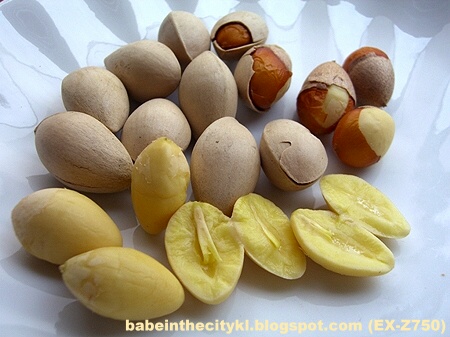
The 8 types of ingredients I've used were red beans, green beans, black eye peas, pearl barley, gingko nuts, dried longans, lotus seeds, and sago pearls. May our country Malaysia will prosper and the citizens continue to live harmoniously and peacefully.

8 Treasure Tong Shui

100g red beans
100g green beans
100g black eye peas
100g pearl barley
150g gingko nuts
150g dried longans
1 rice bowl full of lotus seeds, soak with hot water for 20 mins and remove stems when soften
20-30g sago pearls
water
rock sugar to taste

Boil red beans, green beans, black eye peas and lotus seeds with about 2" amount of water above the beans. Simmer in low heat until they are almost soften before adding longan, gingko nuts and pearl barley; taking care to add more hot water when it dries up.

When all ingredients are softened, add more hot water until to the level you prefer your tong shui to be, either thick or thin. I liked mine half ingredients, half water. Add in rock sugar to taste (you can use normal sugar). Turn off fire and serve hot.


Selamat Hari Merdeka!

Friday, 10 July 2009

Red Beans & Lotus Seeds Tong Shui (Sweet Soup)

Red Bean and Lotus Seeds Tong Shui

Red Bean Soup (hoong dau shui) forms a part of Chinese's snack or dessert staple. Every Chinese household would have their mothers or grandmothers cooking a big pot of this to be enjoyed as snack or dessert especially when they're frying a batch of bee hoon (zhau mai fun, rice vermicelli). They also tend to appear in parties and yes, you would see the big tray of zhau mai fun on the table too!

Red Bean Soup is Capt'n Hook's favourite tong shui (sweet), simple but yet yummilicious. I've done Red & Kidney Beans Sweet Soup and Cream of Red Bean (hoong dau sar). Here's another version of Red Bean Soup. This version contains lotus seeds.

To make this, prepare dried lotus seeds by soaking them in warm water until the seeds got rehydrated. Proceed to split the seeds and remove the yellowish greenish stems as these stems will caused the seeds to taste bitter. Once done, you can boil or steam them till soften and set aside.

In the meantime, wash the red beans until water runs clear, remember to rub them in between your two palms as the beans can be rather dirty. You can soak the beans in warm water for about 20 mins but it's fine if you don't.

Boil the red beans in a large pot, uncovered (unless your pot is very tall else the content will spill), with about 2 times water of the height of the beans with low heat. Keep checking, add more hot water if it dries out too much. Once the red bean turned soft, add more hot water until your desired consistency, we liked ours half water, half beans proportion. Proceed to add in some brown rock sugar (or you can use normal sugar) and some washed and drained sago pearls. I loved my Red Bean Soup with sago pearls as it thicken and smooten the soup texture. Add in the lotus seeds. Let it come to a slow boil and cook until the sago pearls turn clear. Turn off the heat and serve Red Bean Soup hot or chilled.

We loved this soup by dunking in yau char kwai (Chinese crullers) or soak the yau char kwai pieces inside the hot sweet soup. Good enough as an afternoon snack or at times for our breakie.


BTW, anyone tried making this using a pressure cooker? I tried a couple of times but both times I have the beans spilling out of the errrr watchacalldatthingamagik (valve??) and I could see reddish smoke coming out there too!


Technorati Tags: +

Friday, 10 April 2009

Bubur Cha Cha Using Cocopro Coconut Paste

We picked up a couple of packets of Cocopro Coconut Paste during the second launch of MyNourishment. I told the girls there that I'm gonna make Bubur Cha Cha with them and true enough I set to work that very weekend.


Cocopro Coconut Paste - front Cocopro Coconut Paste - back

I was using Amy Beh's recipe from her first book but modified along the way omitting black eyed peas and sago pearls as her recipe in the book consist of the method of making the starchy dough.

To make the starchy dough, divide 150g tapioca flour into 2 portions and place into 2 mixing bowls. Mix red colouring with 70ml hot water and another 70ml of hot water with green colouring. Pour the hot water into the flour separately and mix with wooden spoon. Mix well to form a pliable dough. Roll out each portion with rolling pin and cut into shapes of your choice. Dust the pieces with tapioca flour then steep in boiling water. Stir to prevent them from sticking. Boil until they float to surface. Remove and soak in cold water for 10-15 mins. Remove and set aside.

I've used 600gm of sweet potatoes of the orange and yellow variety and 700gm yam. For the first packet of coconut paste I added 250ml water as per instruction. After tasting, there isn't enough coconut milk, so I added the next packet mixed with 150ml water. Add in the starchy dough before serving.

I find this Cocopro is easy to use but the taste can't match pure coconut milk. It doesn't have that coconut oil smell nor taste though unlike some brands. The other brand that I fancy if I can't find fresh coconut milk is Ayam brand's which tasted like the real thing and most importantly doesn't have the coconut oil smell nor taste. They come in a light version too.

Sorry the picture came out lousy and yucky as it was a gloomy day.

Bubur Cha Cha made with Cocopro Coconut Paste

Gula Melaka Version of Bubur Cha Cha
Bubur Cha Cha


Technorati Tags: +

Tuesday, 22 July 2008

Sea Coconut, White Fungus, Dried Longan and Gingko Nut Tong Shui

I've posted this up before but this time I got a better pic to show.

sea coconut, gingko nut, longan and white fungus sweet soup

Check my older posts about this tong shui.


Technorati Tags:

Tuesday, 27 May 2008

Cooling Drinks Series: Sea Coconut With Buddha's Fruit

The weather in Kuala Lumpur has been tremendously hot. I guess it's time to continue my cooling drink series. I was meant to boil this Sea Coconut With Buddha's Fruit (loh horn guo in Cantonese) tong shui (sweet soup) featured in Amy Beh's cook book but I didn't realised I ran out of dried longan so I sub it with some white fungus instead just for some substance.

Anyway, I just boiled them in a pot for an hour plus instead of double-boiling. I added the rock sugar towards the end and I doubt I've used that much of sugar since Buddha's Fruit will sweeten the soup. So add little by little till you achieve the sweetness that you prefer. Best when eaten cold.

Sea Coconut with Loh Horn Guo

Sea Coconut With Buddha's Fruit

250g fresh sea coconut (to obtain toddy palm seed)
4 red dates, pitted and halved
25g dried longan
1 whole Buddha’s fruit, lightly cracked
150g rock sugar
500ml water

Remove the hard shells off the fresh sea coconut. Tear off the membrane and cut the toddy palm seed into thin slices.

Put rock sugar, red dates, longan, lo han kor and water into a double boiler. Cover and double boil for 1 hour over medium-low heat.

Add toddy palm seed slices and continue to double boil for another hour. Serve hot or cold.

Technorati Tags:

Friday, 5 October 2007

One of Chinese Cooling Drink

This post is dedicated to IX XI :-) I hope the name and photo would be able to help you with your purchase and cooking.

Errr I don't know the name of this drink/sweet soup (tong shui) but if you can read Chinese, check on the packet below. Nowadays the Chinese Medicine Hall tends to prepack their herbs readily for buyers' convenient. I just bought this packet without asking for its name, silly me!

Chinese Cooling Drink02

This packet of drink consisted of the following:
Suet Yee (White Fungus)
Pak Hup (Lily Bulb, Mandarin is Bai He)
Yuk Chuk (Mandarin is YuZhu)
Dried Longan (Mandarin is Longyanrou)
Lin Chi (dried lotus seeds, Mandarin is LianZi)
Candied Ginseng (Mandarin is Renshen)

Chinese Cooling Drink Ingredients

All I did was dump in all the ingredients into a pot of water (use more as it will dry up as you boil along, however, if you think the ingredients ratio is too much as compared with water after boiling for 2 hours, add in hot water bit by bit to your desired amount) and simmer on low heat for about 2 hours. Sweetened with brown rock sugar to taste towards the end.

Chinese Cooling Drink01

Kinda like the usual Pak Nien Hoe Hup but this one have candied ginseng which is the first time I came across this item. This candied ginseng did lend a hint of ginseng flavour in this drink.

Technorati Tags:

Wednesday, 25 July 2007

Black Eyed Beans Tong Shui

Black Eyed Peas

Got some black eyed beans/peas to make some sweet soup (tong shui) since it has been a long while I have this.

Easy peasy - boil the beans until tender (much faster than red beans!) before adding rock sugar to taste. Then swirl in beaten eggs. Done!

Black Eye Peas Tong Shui


Technorati Tags: +

Thursday, 14 June 2007

Water Chestnut Tong Shui

After a very jelak siew yuk yesterday, how about some refreshing and cooling tong shui (sweet soup)? Hmmm it has been a long time since I've posted anything in this series.

Waterchestnut Tong Shui

This version is easy peasy. All in all, it contained chopped water chestnut, gingko nuts and red dates. Boil all of these with some water for about 40 minutes (add more water if the water dries out) before adding more hot water (the actual amount of tong shui you want to yield) and rock sugar to taste. Let it boil for another 10 minutes or so before serving hot.

Can be served cold too but I prefer this hot. Nice...

Technorati Tags:

Wednesday, 15 November 2006

Sweet Peanut Broth (Thor Tau T'ng)

My mom had made this tong shui (sweet soup) before but it was sometime back. I chanced upon the recipe when I was browsing thru Nyonya Flavours that was jointly published by The State Chinese (Penang) Association and Star Publications (M) Sdn Bhd.

This Sweet Peanut Broth (in Hokkien known as Thor Tau T'ng) is basically whole peanut in a sweet broth. Very easy peasy to make and it's best served with some Chinese crullers (yau zhar kwai in Cantonese). I did not follow the amount of ingredients in the recipe so I just guesstimate along.

peanut soup with crullers02

Sweet Peanut Broth

300g skinned peanuts
150g sugar
2 litres water
2 pandan leaves, knotted

Wash the peanuts and soak for at least 30 minutes.

In a pot, bring sugar, water and pandan leaves to a boil before adding the peanuts. Simmer for about 30 minutes or until the peanuts are soft. Serve warm with fried Chinese crullers.


I have been shoved with a new project of late so I have been rather busy, hence updates could be sparse here.

Technorati Tags:


Tuesday, 30 August 2005

Mar Thei Khang (Water Chestnut Tong Shui)

This is how water chestnut looks like. Best thing is this err is this a fruit or vegetable or bulb?? Gosh whatever it is, best thing is this can be eaten fresh after peeling the skin or cook it in sweet or savoury (dumplings and pan fried patties) dishes.

Image hosted by Photobucket.com

Water chestnut (mar thei in Cantonese) are usually grown in paddy fields in China which explains why they are so muddy. Usually I get those in a mesh bag that have already been cleaned. All I need to do is to peel them off before eating or cooking.

This round, I made a sweet soup (tong shui in Cantonese) but this one is call khang. Sorry huh I'm not Chinese educated hence I can't really tell the difference between tong shui and khang but I deducted khang is a thick broth.

This Mar Thei Khang is another easy peasy dish to cook and sorry to say I did not follow any recipe, I just guesstimate my way after tasting this at KTZ.

All I did was peel and chop water chestnuts into small pieces. Place into a pot of water together with a can of sweet cream style corn and boil. I've used some rock sugar to taste. Boil for about 15-20 minutes, then I stir in a cornstarch and water solution. How thick you want your tong shui depends on the ratio of cornstarch and water. Use more starch if you prefer thick soup. Just remember to keep stirring when you add in the solution. It's best to use potato flour as the thickening agent but I do not have any. No problem to substitute with cornflour. Bring to boil and remove from stove. Best served hot.

Image hosted by Photobucket.com

Note: Try not to stir too much after cooking as the soup may turn watery.

Friday, 8 July 2005

Far Sang Woo

Far Sang Woo (Peanut Soup or was it Porridge in Cantonese??) is one of my favourite tong shui (sweet soup in Cantonese). Nothing beats a bowl of smooth and creamy far sang woo. This far sang woo is rather tricky to make, if the peanut is not grinded fine enough it will be grainy. Should the far sang woo is not stirred and mixed properly, it will have lumps. The ratio of the liquid and ground peanut must be the right proportion too, otherwise the soup will be overly thick or too thin to be considered a woo. Some seller take the quick way and use peanut butter but that make the woo tasted slighly salty urghhhh...

Sighhh that's why I never attempt to make any. It's just too leceh (troublesome in Malay) plus I'm quite leceh to be pleased too kekekeke. So far there is only one place in Kuala Lumpur that I find the far sang woo is to die for... KTZ (Kei Tuck Zhek literally means Remember to Eat in Cantonese). Recipe is here if you so decided to make an attempt and please do let me know the result.

This bowl is the tar pau (Cantonese means take-away, a term commonly used in Malaysia) version. Hmmm... really fits my perfect version of far sang woo - creamy, smooth, not too thick nor thin, sweetness is just right.

Image hosted by Photobucket.com

This KTZ started off with a humble beginning in Kepong Baru. They started off by selling mostly dessert like tong shui and steamed egg custard. Slowy they expanded to sell snacks like dim sum, some Shanghainese delights ie. sticky rice rolls, steamed lotus leaf rice and so forth AND not to be missed all the lovely sago-lo (shaved ice topped with fruits and fruits puree mixed with sago pearls). Business was so good that they've no time to make the steamed egg custard anymore... bwahahaha... I want my steamed egg custard!!! *sniff*

From one hawker stall, they have now expanded to quite a number of outlets ie. Jalan Imbi; Citrus Park, OUG and SS2 in Petaling Jaya. Their latest venture a stone throw from their hawker place in Kepong Baru is a noodle outlet. I've eaten there a couple of times and the noodles are delicious. Will blog about them next time when I bring my digicam to catch some yummilicous photos. All these outlet are air-conditioned except for the main one which is still a hawker stall by the road side standard.

We have tried their air-conditioned outlets but somehow (I'm not sure if it's psychological factor or what) the food served do not taste that great. Whenever we have the sudden attack of cravings for tong shuis and snacks, we will head on to their Kepong Baru stall. It's easy for me since my parents home is nearby, about 10 minutes drive away. Maybe the additional factors of sweating it out plus the lashing of dust generated by the vehicles passing by the busy road hahaha...

Strange it may seems, a few of my foodie friends seem to agree with me. So, I'm not the lone loony woman... hahaha so I'm still ok. Promised to blog more about their food when I have the photos.

Wednesday, 1 June 2005

Japanese Purple Sweet Potatoes Tong Shui

Image hosted by www.flickr.com

Now this is more like the ori(ginal) version as compare to my previous attempt but using Japanese sweet potatoes instead. I have to give two thumbs up for these Japanese purple sweet potatoes are indeed much sweeter in taste and they're not fibrous. Yippeee!!! I hate those fibres cos they tend to stuck in between my teeth urrghhhh....

Just as before, wash, peel and cut the sweet potatoes. Add in a knob of ginger and sugar (I usually use rock sugar) into a pot of water. Simmer in the water till the sweet potatoes soften. Voila... sweet potatoes tong shui (sweet soup).

Image hosted by www.flickr.com

Thursday, 5 May 2005

Sea Coconut

Image hosted by Photobucket.com

Haha they looked like something from outer space, don't they? Fret not, these are Sea Coconut. The brown one is with the outer layer or is it known as husk?? Anyway, after peeling and washing them, it will reveal the jewel bits as seen there, almost opaque.

I've blogged this before here but that one was made by my mother. I've bought a pack of sea coconuts from the wet market and I guesstimate thru what my mother could have done to cook this tong shui (sweet soup). I can't call her to find out since she was overseas enjoying her holiday whilst I have to chase my little bull round home. Sighhh...

Cleaned the sea coconut and prepared the rest of the stuff whilst my boiboi was napping. Dunk into the pot and simmered for a couple of hours.

And this was my version...

Image hosted by Photobucket.com

Sunday, 10 April 2005

Bird's Nest Soup

Something exotic in the menu today hehheh... but it's really nothing exotic on this part of the world. Bird's nest is actually swallow's nest made from their own saliva. Sounded yucky eh? Actually the process is quite tedious from the moment the nests are harvested before it reaches our table. You can reach about it here.

I got this box of bird's nest from Kuching via a friend. Kuching is famous for the majority of the nests came from the famous Niah Caves. However, nowadays the traders set up bird's house to cultivate bird's nest. This is how the boxed up nests looked like. Err bad photos cos I've used XDAII to capture these whilst my poor digicam went in for a checkup at it's clinic.

Image hosted by Photobucket.com

After it's opened.

Image hosted by Photobucket.com

Close up on bird's nest. The colour you may noticed is very different from those usual ones which are snowy white. I was told this is the pure form of the nests where else those white ones are usually bleached.

Image hosted by Photobucket.com

To cook bird's nest, one can either make it savoury or sweet. For us, we usually make sweet ones. First I soaked the nests with some water for a couple of hours. Next clean them up. Since I've bought a better grade nests, not much effort is needed to clean up the nest. The bulk of the feathers have been removed.

Usually bird's nest is cooked using double boiled method but this round I've used a slow cooker instead. I've used 3 slices of bird's nest, 4-5 pieces of dried red dates, a few pieces of sliced phau sum (Cantonese for ginseng I think), 2.5 bowl of water and some rock sugar to taste. I left it simmer on the slow cooker for about 6 hours. Here's how it looked like...

Image hosted by Photobucket.com

Tuesday, 22 February 2005

Pak Nien Hoe Hup


Pak Nien Hoe Hup literally translated means still being together after 100 years. This is a very popular dessert served at Chinese wedding banquet. I made this during Chinese New Year as this sounded kinda like a prosperity dish hehehe...

Anyway, this is one of the simplest tong sui (sweet soup in Cantonese) as it contained 3 ingredients - dried longan, dried lily bulb and dried lotus seeds. Simply boil all of them in a pot of water until the dried lotus seeds turned soft. Alternatively, you can steam the lotus seeds first before adding to the soup. Well, I was lazy, hence, I dunk everything into the pot. Add in rock sugar to taste. You can serve it either hot or chilled. We liked both versions!

Sunday, 23 January 2005

IMBB 11: Red & Kidney Beans Sweet Soup

I'm quite excited about this actually, no, I didn't mean in cooking this tong shui (Cantonese for sweet soup or sometimes it is know as sweet porridge). This is going to be my first time participating in Is My Blog Burning (IMBB). Every month there is a theme hosted by one of the food bloggers. This month's IMBB is hosted by Cathy of my little kitchen. The theme is Beans, beans, the musical fruit....

This Red & Kidney Beans Tong Shui is a sweet dessert which is very very simple to make. Usually most people will use red beans only for this dessert but some actually add in kidney beans for a slighty different texture. I've used large sago pearls this round.

In order to shorten the cooking time, I soaked the beans in hot water over night. Remember to add in a lot of water as the beans can absorb quite a bit of water. Drain off the water and add them into a pot of water of maybe 3 inches higher than the beans. Slowly simmer the beans until they're soften. This might take 1 to 2 hours. You may shorten the cooking time by using a pressure cooker. Make sure you check on the beans every now and then to avoid the water being dried up plus give it a stir too to avoid the beans stick to the bottom of the pot. I used non-stick pot to avoid this from happening hehehe... Add hot water to the pot when necessary.

Next, dump in the washed sago pearls and cook till translucent. Twist some screwpine leaves (pandan leaves) into a knot and place into the soup. Then add in more hot water once the beans are soften and the sago pearls are cooked. The amount of water depends on your liking. If you prefer a thicker soup, add lesser water. If you prefer a more watery soup, add more. I usually prefer equal portion of water and beans. I like to use rock sugar but you may just use granulated sugar. Add in according to the level of sweetness you would prefer. You may also add in steamed dried lotus seeds.

Serve it either hot or cold. This is how it looked like.


I always cook this tong shui all the time as it's my husband's fave plus it's one of the easiest to cook. You might wanna check this recipe out.

Thanks to Cathy for organising this round of IMBB. Looking forward to the next IMBB.

EDITED: Replaced the picture with a better one.

Thursday, 16 December 2004

Air Mata Kuching

There is this famous air mata kuching (literally translated as Longan Water) in KL's Chinatown (also popular known as Petaling Street). Each time hubby & I are in that area, we will naturally stop by this stall and drink the ahhhh soooo nice and cooling air mata kuching. Any KLites like me or hubby?? Hehehehe...

Since we hardly go to Chinatown these days, we'll usually boil some to enjoy it hot or cold ala Petaling Street style. The ingredients are pretty simple, just need to get some fresh winter melon (tung kwa in Cantonese), Buddha's fruit (loh horn guo in Cantonese), dried mata kuching flesh (longan in Cantonese) and some rock sugar.


I usually grate winter melon into thin strips. I've tried cutting them manually but somehow the results do not yield what I liked and it took longer to boil them. Well, unless you have very good knife skills to cut them really thin! Dunk them into a pot of water. Break up the Buddha's fruit into pieces and place them plus the dried mata kuching flesh into the pot. Boil until the winter melon turned transparent like. Add rock sugar to taste. Serve either hot or with crushed ice (which resembles the Petaling Street stall!!).


Monday, 13 December 2004

Old Cucumber Leung Shui

Leung Shui or sometimes also known as leung char, literally translated as cooling tea, a drink to balance out the body's yin&yang thingy haha... well more like to cool (yin) down our heaty body (yang).

I bought this old cucumber hoping to turn it into a soup but something cropped up so I can't cook for that weekend. Had wanted to pass it on to my mum and she told me I could use my slow cooker to turn that into leung shui.

Oh what a brilliant idea cos its really easy to make. Wash the old cucumber with a brush. Cut it up into slices and discard all the seeds. I boiled the old cucumber with some rock sugar and lots of water in my slow cooker over night for about 6 hours.

It came out very "fragrant" and it's pleasant to drink. We scooped out the flash as we drink it for some bites. I think boiling them with a stove would render a more "ummphh" taste hehe


The other alternative of similar leung shui is to scrub clean a watermelon before cutting up. Then cut out all the red flesh to be consumed fresh. Reserve the skin (the white flesh and green skin) and chopped them into small pieces. Boil the skin with rock sugar and water for a couple of hours on the stove on a slow fire. This drink tastes very very nice. We love it! So it's kinda two-in-one thingy, what a wonderful fruit!!

Thursday, 9 December 2004

Sweet Potatoes Soup

This is one of the easiest tong shui (sweet soup) to make. Buy sweet potatoes in different variety of colour. Cube them and boil them in water till tender. Add in a bit of crushed ginger (more if you prefer a stronger flavour), pandan leaves and sugar to taste.

This could be the result...


I've added in additional steamed gingko nuts and yam (I just love them) this round.

Blog Revamping

Hello... I'm in the midst of revamping my blog to make my life a little easier. So do not be alarmed as work is still under construction.

Cheers,
Babe_KL
16 Oct 2012